
Approx. reading time:
There aren’t enough hours in a day.
There always seem to be too many tasks for too few people and everyone is short on time. It’s our most precious resource and many of us are wasting it because we are misunderstanding a fundamental difference between managers and makers and how they do their best work.
If we can find a way to work around schedules, we’ll find more time to get things done. So let’s meet our spectrum.
Makers are people who spend their time making things. These are artists, engineers, coders, architects, writers, and lots of creatives. Who are managers? Managers are the accounts people, the people who make sure ideas transform into money. They are the assistants, they work with clients, and they lead meetings. Managers keep the business going.
In the creative industry, there is a lot of overlap between makers and managers, and there is also always a little bit of tension between accounts and creatives. Because creatives need to spend time making the work, but then have to work on a manager’s schedule. Right now, the Managers have set the way we do our work, and it’s time we take the makers into account, especially in advertising.
Work involves a lot of meetings. Over the pandemic, meetings made up the bulk of our work time. This is very difficult for a creative worker. Meetings begin to feel like interruptions that cut up our day.
We need to start looking into the nature of our tasks to come up with proper schedules that can work for everyone. Right now, we can do it! We are in a unique position. The world has just ended, and we have changed the nature of work from f2f to WFH. This fundamental shift might make it possible to break the wheel once again.
Making more time would be a lot of help to a lot of people. Especially in this industry where we tend to glorify long hours. It’s tipping dangerously close to a culture of karoshi, a word meaning death from overwork.
That kind of dedication is fetishized in our industry and it’s time to stop.
We could be looking into how to make our work more conducive to people and not the other way around. Sei-katsu-sha means a human is more than a robot or automaton constantly working. We need more than just a job well done.
But how can we get everything done, and take initiative, and have a life outside work when we only have so many hours in a day?
We make more time by managing it better.
The Maker Vs. The Manager’s Schedule
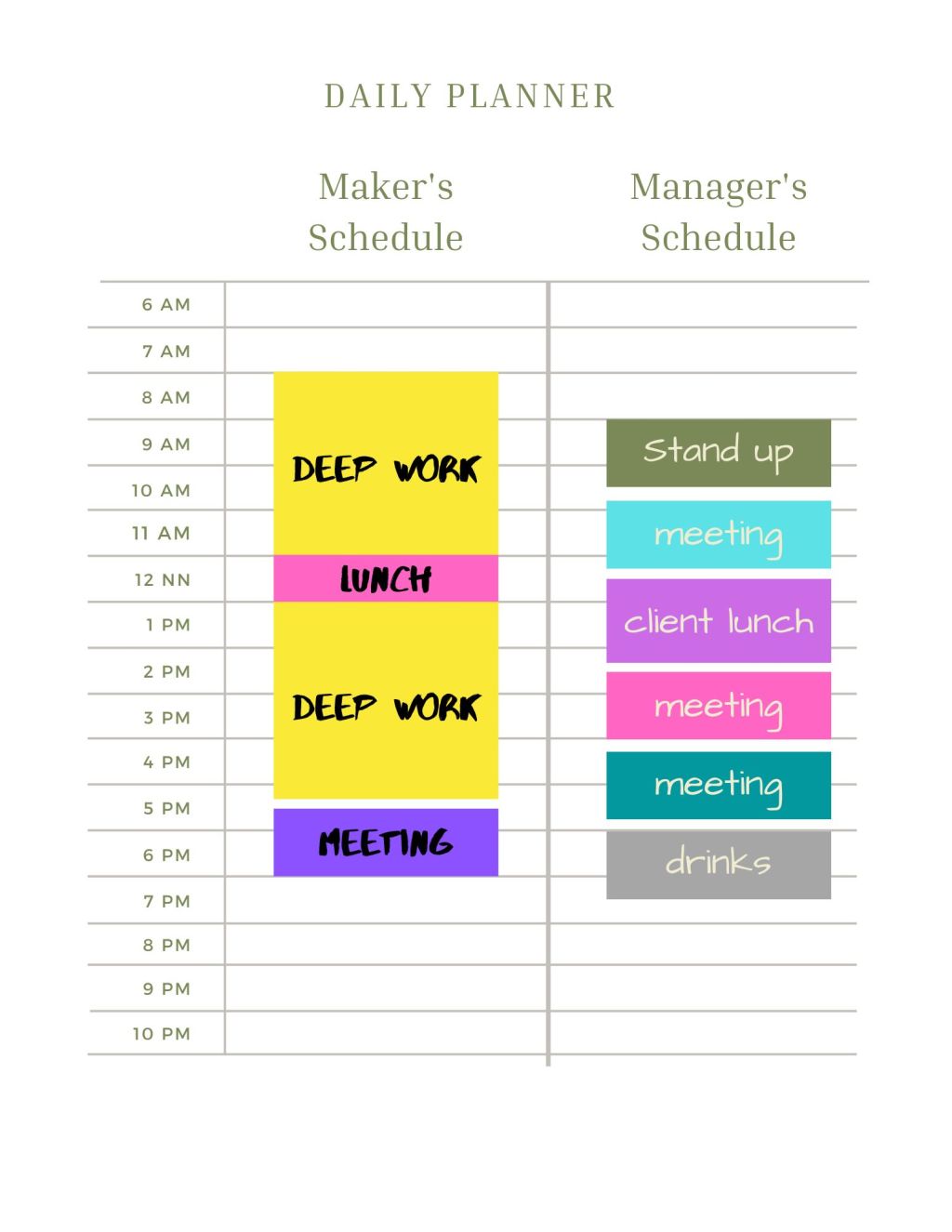
Managers thrive in this environment of meetings. They work well when their day is scheduled into small chunks of time. They then devote their focus to each task and then move on to the next. You will recognize this as a common WFH day.
Makers need much bigger chunks of time to get into their work. Unlike managers, they need hours to prep and research before they can even get started. That kind of focus gets ruined when a day is cut up with lots of obligations and meetings. Makers tend to dread meetings because it means they can’t get into deep focused work.
Deep work is where the crafting part of creativity comes in. Deep work takes massive amounts of focus and a lot of time. Every maker knows what deep work feels like, and many will put off deep work until after hours because it takes more than an hour or two to get into it, and then having to go back and forth creates stress rather than satisfaction.
An ideal day for a manager to get a lot of work done is a day with lots of hour-long time chunks. They thrive in meetings where a brisk pace is set so that they can jump from project to project and help make the decisions on how to move forward.
Creatives have totally different needs. Unlike managers, they don’t usually work that way. It takes hours to get into the zone when you are working and a single outside responsibility can make it hard to concentrate.
This is why so many creatives get their best work done in the wee hours of the morning, there is no one to interrupt their little bubble of work. But do we need to move that bubble of work in the wee hours of the morning into work hours… or do we start working asynchronously?
What Is Asynchronous Work?
Asynchronous (async) work is work that’s not done at the same time. You aren’t working alongside your team members but rather carving out the time that works best for you. We’ve already determined that we can work in different places, it’s time we embrace that we can work at different times as well.
If you gear your meetings and requirements to work that will be done later, you might find your productivity rising.
If you find you work best late at night, then don’t consider that overtime, consider it part of your work schedule and take the hours of the day between meetings off. Break out of the 9-5 work schedule, you’ll find that you get more work done when you can choose when to do it.
Eschewing Karoshi Culture
There is a problem. There is a performative aspect to work that can be very harmful. Work can become a competition that goes on between colleagues sometimes to show how hard they are working. There is a culture that is emerging that glorifies overwork and staying overtime.
Overwork doesn’t always mean good work. Constantly working doesn’t mean you are a better employee.
Little by little, we are starting to see karoshi culture start to creep into the Filipino sphere. There was even a brand strategist who passed away from overwork at an agency a few years ago. Karoshi is a worldwide phenomenon but is a prevalent problem in Japan. It translates to “death from overwork”.
There are lots of people who are not taking care of themselves and the end results aren’t pretty. When we work ourselves to death there is no gold star at the end. Being stressed all the time is not going to be good for your long-term health which is, in turn, bad for business.
It’s in everyone’s best interests to create a system where everyone can thrive.
Making Time Where There Wasn’t Any
We are in a unique position right now. Because the world has just undergone such a big change, we are shown that change is indeed possible and not as scary as we originally thought.
We might be able to even convince the managers that maybe this 9-5 workday was a mistake and that’s not how people are supposed to work. After all, weekends were invented in the 1800s. There is no real reason we need to work 40-hour work weeks.
Just a few years ago companies would say that it is impossible to have their workers do their jobs from home. But now remote work has become the norm, pretty much everyone is working in a hybrid system of WFH and going into the office.
Let’s take that openness toward change and apply it to our work schedules.
Maybe it’s as simple as limiting client meetings to three days a week and letting creative have two days of just executing time so they can really get into a good groove. Maybe directors and leaders can stop thinking of five-day work weeks as the be-all and end-all and have creatives work 10 days on and 5 days off. It might be a difficult thing to schedule but that’s what we have computers and data crunchers for.
It’s time we rethink how we do work. Not just how we do it, but when we do it.
Why It’s So Important To Cross Lines
This is why it’s so important to be aware of all the requirements of all your team members, creatives and accounts alike. When you are working on a team, especially in the advertising industry, you are balancing a lot of different needs. The accounts people are going to have requirements from the clients, they are going to have briefings and clearings, and all sorts of day-time work. But they have the upper hand, the world is already geared towards their working style. It’s up to them to help carve out time for the makers of the world.
Accounts, your creatives might need to be shielded from all that buzz. They might need to concentrate on making good work for your clients. Their work is the backbone of the product you offer so making sure it’s the best it could be is paramount.
Understanding each other’s work and how we differ is key. Now that you know that makers work differently than managers, how are you going to change how you plan out your tasks for the week?
Time Is Relative
Not everyone works the same way, but as a rule, creative makers need larger chunks of time to do their work well. Unlike managers who thrive in meeting spaces, creatives tend to need to hermit it up and do their work in solitude with no interruptions for hours at a time.
We need to start acknowledging that we do work differently so we can start to find workarounds and make everyone more productive. We have just redefined work in a big way, there is no saying we can’t do it again.
When we make time for makers to work, we are creating time. If we adopt this new line of thinking, we can start hacking the hours of the day to be more productive. All it takes is a little understanding.
 Journalixm