

Approx. reading time:
There’s a massive market that entertainers, advertisers, and brands don’t really engage with yet—and there’s a good chance that you are part of this invisible demographic.
This “secret” socio-economic class is known as the Emerging Affluent. According to a study by the Hakuhodo Institute of Life and Living (HILL) ASEAN, they are one of the most dynamic markets out there. The problem is, because most of us aren’t aware they exist in the first place, we immediately miss out on the opportunities they present.
In fact, most of us doesn’t even know that we’re part of the Emerging Affluent.
So how do we know this invisible market exists? And what do they look like?
According to Emerging Affluent: Discovering the Invisible Socio-Economic Class in ASEAN, a HILL ASEAN report shared with various brands and media members last June 23, 2023, the Emerging Affluent are those with monthly household incomes that fall between middle-class and wealthy. In the Philippine context, that means households that earn between PHP100,001-130,000 a month. But what actually defines them isn’t something quantifiable, and this is why they’ve managed to stay unnoticed for so long.
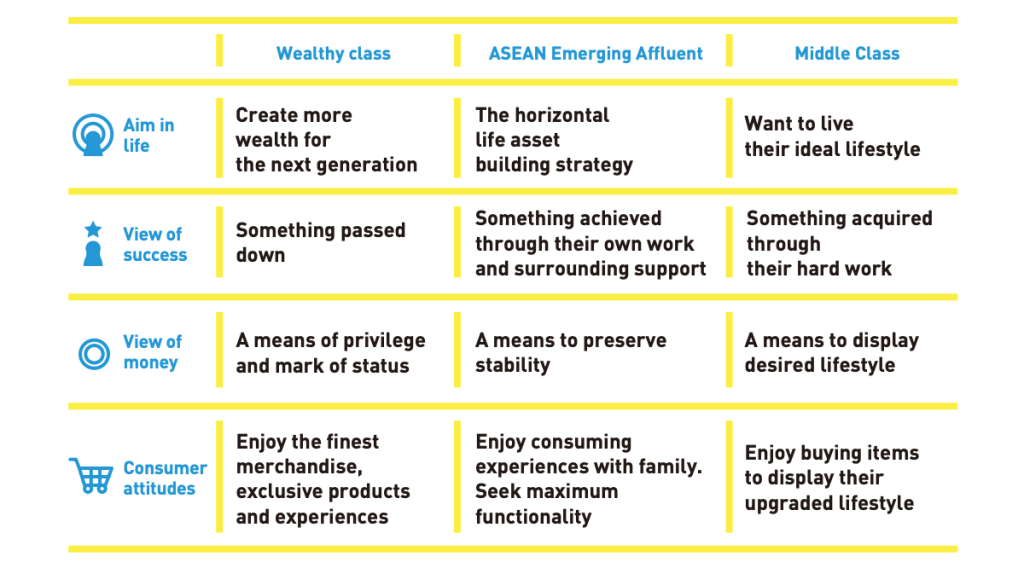
Unlike most other socio-economic classes, the Emerging Affluent are defined more by their qualitative data. Rather than being a hard demographic, they are a dynamic psychographic, driven by their wants, needs, and aspirations. They are, in many ways, a market that can only be seen through the lens of sei-kastu-sha, because the Emerging Affluent is more of a state of being than a strict categorization.
As Chief Network Officer for Hakuhodo International and President of Hakuhodo Philippines Third Domingo puts it, “The Emerging Affluent is not just a real subset, but an eternal human mindset.”
Even though this breaks traditional classifications, HILL ASEAN believes that there still can be data-driven ways of communicating with the Emerging Affluent. Brands and creatives simply have to focus on the qualitative data rather than the quantitative; to recognize this audiences for the whole human beings they are rather than an amalgamation of faceless numbers.
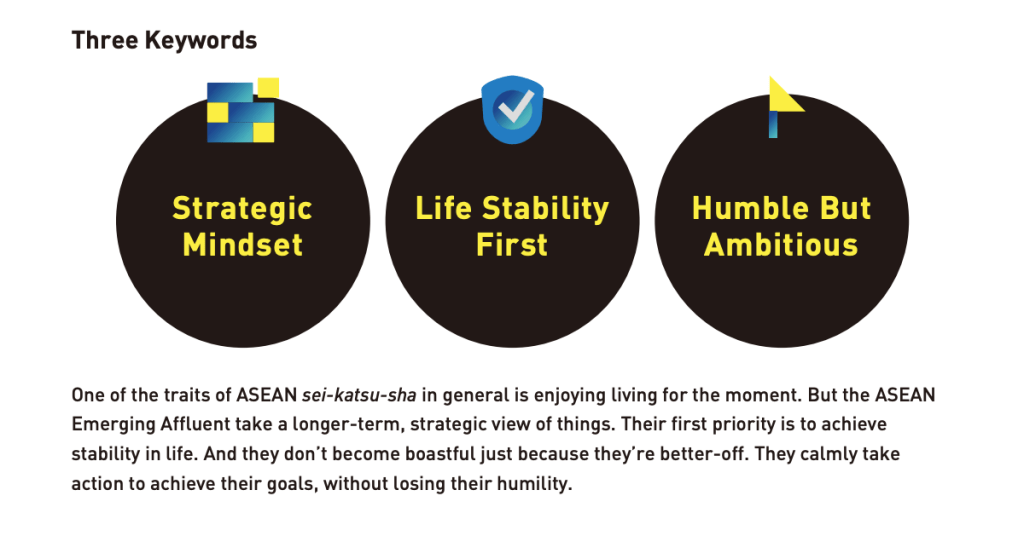
Through a study consisting of 2,790 online interviews and 44 home visits across the region, HILL ASEAN was able to paint the following portraits of this previously untapped market, in their respective countries:
They are Relationship Amplifiers
The Emerging Affluent value their interpersonal connections, and understand how good relationships can help them find more success in life. They value having a sense of community both online and offline, and tend to favor brands that offer this through a combination of special experiences and excellent service.
This archetype is seen most strongly in the Philippines, where people tend to leverage their personal networks into gaining more opportunities. This makes them very selective people-choosers: they make sure that the people they keep closest to them are those who can help them move upwards in life. At the same time, however, they also have a sense of empathy when it comes to being discriminated against, so they do their best to make others feel welcome.
The Filipino Emerging Affluent’s personal networks also help them achieve their ambitions in multiple life aspects. They believe that a balance between aspects such as career, hard and soft skills, relationships, and hobbies results in general life satisfaction. Rather than compete with each other for the Emerging Affluent’s focus, it’s their complementarity that Filipinos value.
They are Humble Hustlers
One of the most common sentiments among the Emerging Affluent surveyed by HILL ASEAN in Thailand was that they like to stay relatively low-key about the luxuries they enjoy. They prefer to limit the attention they get, while at the same time being made to feel special.
This suggests that the best way to reach them is through a “subtle VIP experience” that allows them to choose exactly how much attention they draw whenever they engage with luxury brands.
They are Nurturing Playmakers
The Indonesian Emerging Affluent tend to prioritize the long-term happiness of the people around them, and make their decisions accordingly. They’ve gotten past the “surviving” phase of adulthood and are more keen on building stable foundations from which their family can continue to grow.
As such, they’re interested in brands that they can see as long-term partners, opening up opportunities in after-sales touchpoints.

They are Proud Mind-Freedom Seekers
Because Vietnam’s Emerging Affluent recognize that their current status in life can be attributed to their personal growth, a sense of self-improvement continues to drive them forward. They understand that the freedoms and flexibility they enjoy today can only be maintained if they continue learning.
For brands and creatives, this opens up interesting avenues for engagement. If they can position themselves as “personal growth partners” for the Emerging Affluent, they’ll be appreciated as the market’s motivators.
They are Thriving Uplifters
This premium on growth extends to the Malaysian Emerging Affluent’s families and social circles, as well. They want to share whatever growth they enjoy with the people they care about, effectively “raising the floor” in terms of lifestyle and capabilities for everyone.
By creating “shared growth experiences” such as family gym classes or group learning bundles, brands can help the Emerging Affluent take care of the important people in their lives.
They are Multi Capability Builders
Because the Emerging Affluent in Singapore have more or less achieved their primary markers for success—owning a home, starting a small business, etc.—they now look for additional non-material value in their investments. This makes them even more meticulous researchers than before, as any product or service now has to not only be cost-effective in the financial sense, but it also needs to fulfill their needs on an emotional, spiritual, and philosophical level.
The Emerging Affluent favor products that are capable of bringing value to them in multiple ways—“functional luxury” over straight luxury, so to speak. It’s not just about how fast a car can go anymore; it’s also about how much use their family can get out of it, the different ways it can be used, and even its impact on the environment.
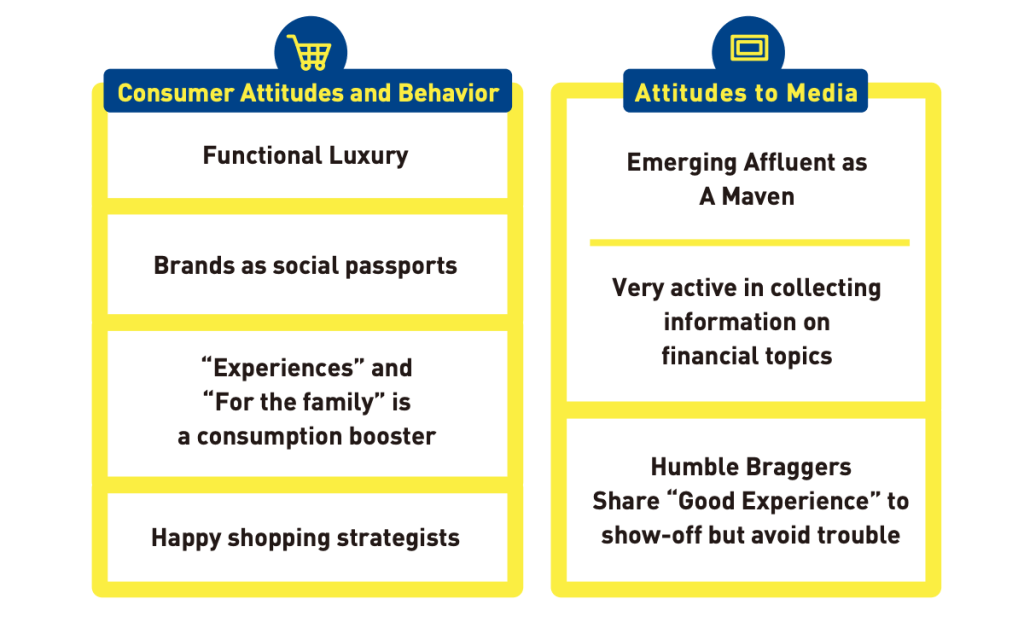
Collectively, the Emerging Affluent in the ASEAN region are interested in brands that characterize three Ls: Low-key, Longevity, and Love-tribution.
They’d rather stay Low-key when it comes to premium goods, and prefer to maximize their functionality over their flashiness. They are relentless information-seekers, always looking for items that offer the most fulfillment without necessarily calling for others’ attention.
They prefer brands that offer them Longevity not just in terms of product durability, but also in terms of their family’s relationship with them. They are the life-planners of their own personal circles, and appreciate having a partner than can help them grow over the years.
And lastly, they believe in Love-tribution, or sharing their good fortunes with friends and families. They want to others to experience the happiness their affluence brings them, not only because they value their relationships, but also because it’s the least-selfish way to enjoy their wealth.
Odds are, you’ve met at least one Emerging Affluent in your life and didn’t realize it. Now that HILL ASEAN’s found proof of them being a significantly sized market, brands and creatives would do well to keep an eye on them. For Filipino brands, that means creating messages that resonate deeply with the Relationship Amplifiers.
The Emerging Affluent are an audience that can only be seen through a sei-katsu-sha perspective. It’s time for brands to make sure that they’re always going to be visible.
 Journalixm