
by Vince Agcaoili
Approx. reading time:
1.
I have always enjoyed what language can do. That, in most days, it is like a cloak that loosely envelops our most novel and ordinary ideas or perhaps our lightest and heaviest sentiments. And that, in rarer occasions, it is more exact and exacting, enough to enact or embody our very ideas and sentiments as if in flesh. Of the first example, I have in mind ordinary speech: this sentence, a street sign in the heart of a city, the headline you laughed at this morning. Of the second example, I have in mind poetry: language in itself or, more precisely, the wielding of language to enact or embody the world in its appeal to the imagination. It seems to me that, in poetry, with its exactness with language and its affair with imagination, what is merely possible can be so alive that it can pass to be real.
I never actively pursued poetry. In fact, I never thought that the simple task of writing a good poem would become a grand and constant aspiration. My relationship with literature began with fiction. I studied it. I read it day and night. I devoured every book I could get of it. At some point, I tried to write it. I managed to finish a few stories, but in hindsight, it seems like the work was doomed to fail. This was because my younger self was more concerned about diction than the events that were supposed to take place. This fixation with words extended beyond literature: Outgoing emails received more attention than they should have gotten, text messages became a space to ask myself where a comma would be placed, and undergraduate papers were testing ground for some rhythm or tone of an unnamed persona. I did not know it then, but I suppose that during these more innocent times, I already had the assumption that language can do things to people.
2.
I do not think of myself as a confessional poet. I believe that the mind of the man who experiences the adversities, joys, and senselessness of everyday life is a necessary repository for the memories and sensations of our lived lives. I believe, too, that the poet who crafts the lines must converse with this man whose mind is a repository of memory and sensation – to ground the poem on concrete feeling or thought, to tap the vein of this human life – but he must essentially write from him. At the end of the day, it is my view that poetry belongs not to its craftsman, but to the people who will read it, the people who might recognize their own lives in the mirror of specificity that language holds up to the world.
3.
The question of how exactly I write always feels like cold water at the start of the day: intimidating but necessary to get over with. I say this because a question demands an answer. Unfortunately, I find that, most times, I grapple with questions in order to begin a poem. In my own practice, I take it as a necessity to be as open to the opportunities that abound the white page as I am open to the world and its possibilities. There is a feeling of urgency to start somewhere, anywhere, that this confrontation with the immense wall of the white page instills in me. It is not difficult to imagine how one can easily fall trap into the vastness and openness of both spaces, world and word.
At this point, I latch onto anything I can get a hold of to craft my first line. This can be a word I may or may not have used yet in the past, an image, a phrase I heard somewhere, or, perhaps, a rhythm of a breath, or the weight of a voice’s tone. Everything is a possibility. Whatever the case may be, this is the point in my ritual of writing where the first line gets all the attention I could possibly draw from myself. One certain observation I can make is that I cannot progress through the rest of the poem if I do not feel some bottled-up energy in the first line, a force that will compel me to not fight with it anymore, a pressure that may propel me onto the next line.
4.
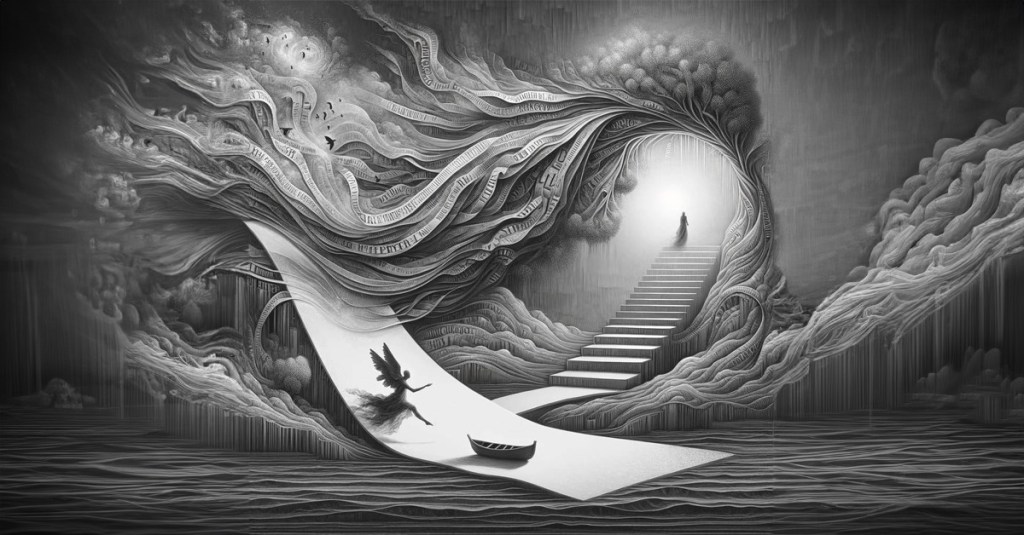
Sometimes, I think a poem is like a long staircase in a very dark house. One will have to grasp for the handrail, and sometimes, even the next tread to step on just so one can carry oneself from one floor to another, just so one can move and get to know the house better. The house is there for the discovery, and the task that befalls the writer is to search for the next step forward.
5.
I would like to disclose that I have had many reasons for writing at different points in my life. What is true now is that I write because I would like to be read. Not for the sake of recognition, but for the sake of some form of communion. It may be true that poetry is read less compared to fiction, that it is a much slower way to get across a few people, perhaps two or three. But I would like to believe that poetry can be a vessel of consolation – a language formed on a page, passed onto another, bearing a life that we recognize as our own.
What is true now is that I write because sometimes life demands to be looked at through a child’s eyes, and poetry affords us this much. I do not think at all that poetry is complex. The burden of complexity is on our shoulders. Poetry asks us to put the baggage down, hands us a glass of water, asks us where we have been, where we want to go, and makes us feel like somewhere somebody knows how much we have to carry.
Vince Agcaoili has won a Palanca (2023) and a Maningning Miclat Award (2023) for his poetry. He has been granted fellowships to numerous writers workshops, including the 63rd UP National Writers Workshop which will commence later this 2024. His works have been published in the Philippines and abroad. He teaches literature at the University of Asia and the Pacific and De La Salle University – Manila, and plays music for Eskinita. You can reach him at vinceraphael.agcaoili@gmail.com
 Journalixm