
First of a three-part series
by Wilfredo Pascual
Approx. reading time:
Around noon on November 4, 2023, I fell and broke my left arm while riding an e-bike on the eastern side of Angel Island, the second largest island in San Francisco Bay. I had crashed in front of an abandoned garrison, a detention camp built during the Philippine American War near Quarry Beach.
Minutes after I called 911, three firefighters rescued me on a red fireboat. They cut through my purple hoodie and straight black jeans to check for injuries. One of the firefighters showed me the dent on my lilac helmet. This saved you, he said. He went through my wallet and called a medical center in the North Bay. “Male, 55, Medical Number…” When the Xray technician at the ER cut through my vacuum splint, white beads spilled on the floor. Why is it like that? I cried when I saw my left forearm, bent. Don’t look, said the Xray technician.
The surgeon described it to me on a whiteboard. You broke two bones, he said, the radius and the ulna. I asked if it was a clean break. He said if a clean break was 1, and smashed was 10, mine would be a 3. The break on the radius was closer to the wrist, the ulna, to the elbow. He asked what I did. I said I’m a writer. He said, “My aunt is going to be happy that I took care of a writer today. She’s a writer, too. But she’s having a hard time finding an agent.”
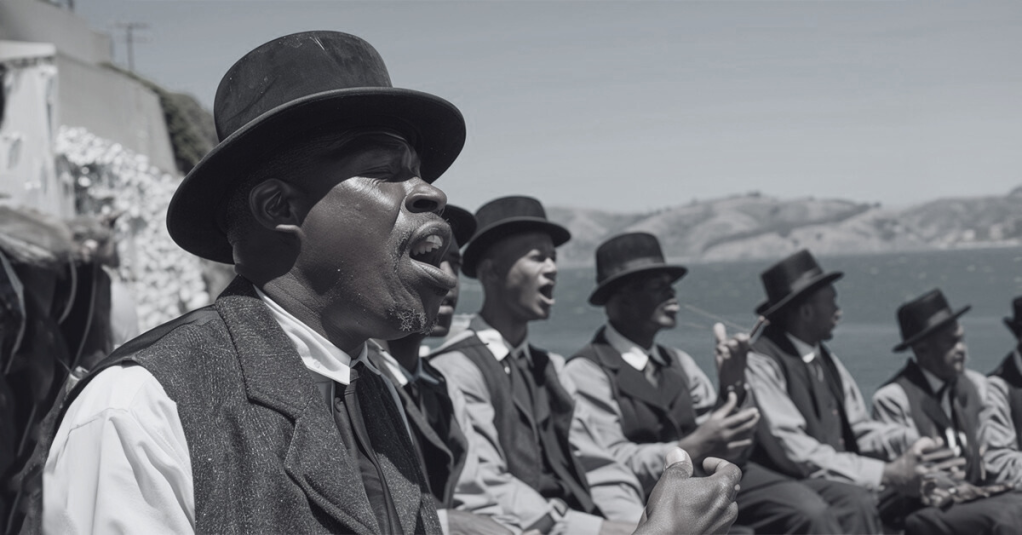
I came out of the ER with hardware—metal rods, plates—permanently screwed to my bones. On my last day, the occupational therapist told me that he has been working on his novel for two years. I said, good luck. He asked me about the story I was researching at Angel Island. I said it’s about the last African American soldiers the U.S. Army sent to the Philippines towards the end of 1899. Hundreds of them were quarantined in the island when three soldiers tested positive for smallpox. During their time in the island, the soldiers organized a 400-man choir.
124 years ago, the African American soldiers rehearsed on a slope overlooking a quarry where they could see men with picks and hammers swinging at rocks all day. There used to be a hill at the quarry, a hundred feet high. It’s where prisoners from Alcatraz cleaved out the rocks upon which the foundational structures of the Old West were built—the California Bank, Fort Point, the Presidio. I viewed and studied the area for weeks on Google Earth. I imagined the men with the sun in their eyes, humming from the same wounds of the earth, their gaze fixed on the hills of Berkeley across the Bay.
Ten years earlier, in 1888, a very pissed Jose Rizal was also quarantined in the island. Don’t come to America, he wrote to his friends. Americans are not hospitable to Filipinos. They are crazy about quarantine. No one on board is sick, he said.
It’s true. Rizal had arrived at one of the most anti-Asian periods in American history, at the height of the Chinese Exclusion Act. I had crashed in a historical spot, the confluence of rocks and voices against empire and disease. I thought it would only take a few weeks to recover, but my surgeon, who didn’t want me to do anything dumb, kept me in a long arm cast for three months. It stopped me from going out, but it didn’t stop me from writing, from typing with one hand.
Wilfredo Pascual grew up in San Jose City, Nueva Ecija. He worked for 20 years in the international nonprofit space before settling in San Francisco, USA. A multiple Palanca winner and Ani ng Dangal awardee, his essays have earned a Pushcart Prize nomination and a notable citation in the Best American Essays. He has been published in the Philippines and abroad, with his latest work forthcoming in The Kenyon Review.
 Journalixm