
by Juan Ekis
Approx. reading time:
With silence. My soul boots up its OS—does an integrity check; makes sure last night’s defrag sequence was successful. A quiet conversation with the self, with the Maker, with my bed. I guess you can call it a prayer.
With an open window. An open notebook. Or an open word processor. An open-ended song of a mariacapra. A broken-open guava hanging by half a stem, waiting for the fantail to finish its score of the day’s opening billboard. Which usually ends with the title—what Billy Collins calls a poem’s welcome mat. Should work in drama too—or would it? Since drama is not meant to be read, but staged? Still, a title sometimes makes or breaks a show, right? Like how Marilou Diaz-Abaya titled her last trilogy. Four syllables would make it a hit, she said: Jose Rizal, Muro-Ami, Bagong Buwan. Worked for Twenty Questions. My other stuff was either too long or too short—Kapeng Barako Club: Samahan ng Mga Bitter, Ensayo, ’Nay May Dala Akong Pancit, Pingkian. Let the title tell you what it’s about.
With a line of dialogue. A random line. Assigned to a random character. Let another random character respond to it, encounter it, battle with it, be consumed by it. Let the original character reply. Let them converse. Let them fight it out. See where it takes you. Listen to their speech patterns, their choice of words, their varied and conflicting tones. A cliche line from a random soap: “Buntis ako…” How do you respond? What would you say? Let the other character respond with a non sequitur: “Gutom na ako”. Fuck story. Let dialogue shape plot.
With an image. Bird splitting open fruit. Be more precise—maya pecking at chico. Sizzling bacon on pan, oil exploding, evoking the beginning of the universe. The Big Bang was actually God’s Big Breakfast. The song of the taho vendor as the village alarm clock. Or perhaps with a moving picture—a scene. Exes on the roof of the tallest building, waiting for the end of the world. Emilio Jacinto haunted by the ghost of his best friend Andres Bonifacio. A kissing scene interrupted by the curtain or lights out. Demons trapped in a room, trying to survive a siege.
With a premise. A drunk woman asking the love of her life to be her best man at her wedding. Siblings stuck in a metaphysical time loop who are trying to stop the death of their mother. Two senior citizens rehearsing a kiss. An insomniac writer rummaging in the rubbish for a story. A girl with the rhyming sickness that can only be cured by a true love’s kiss.
With space. A cafe, the birthplace of conversations. A hotel room, the playground of Eros. An elevator, the sandbox for awkward skits. A roof deck, the perfect spot for viewing the apocalypse. A back alley, where secrets are killed. An intersection, where plot points converge and get stuck like traffic in EDSA.
With an outline. This is what my mentors and colleagues usually prescribe. A proper beginning, causing a logical middle, causing an inevitable end. This is helpful if you’re on autopilot, beating a deadline, so you could get paid so you could pay rent. You might be surprised how structure can liberate a creative. You’d think it’ll stifle your creative spirit. But you cannot think outside of the box if you don’t see the box. You need the box. I’m not an outline person myself. My best work started with outlines. Though my most popular ones did not.
With consuming art. Beauty begets beauty. My sensei once told me—if you want to make films, don’t just watch movies—start reading books, collect graphic novels, go to the theatre, watch ballet, see concerts, visit galleries, stare at paintings, admire architecture, appreciate sculpture. Consume art. Consume beauty. Expose yourself to the forms. Deconstruct them. Reconstruct them. Let them possess you as a muse possesses her artist.
Six weeks ago, my friend Kael asked me to write this short essay for their publication. “Simpleng prompt lang, mga 800 words, ang tanong ay: How do I begin?” He gave me a week. I opened my word processor and stared at the blank page for almost an hour. How the fuck do I begin?
With silence? With an open window? A title? A line of dialogue? An image? A scene? A premise? Space? An outline? With watching a whole bunch of Netflix justifying to myself that I am consuming art? How does one begin to create?
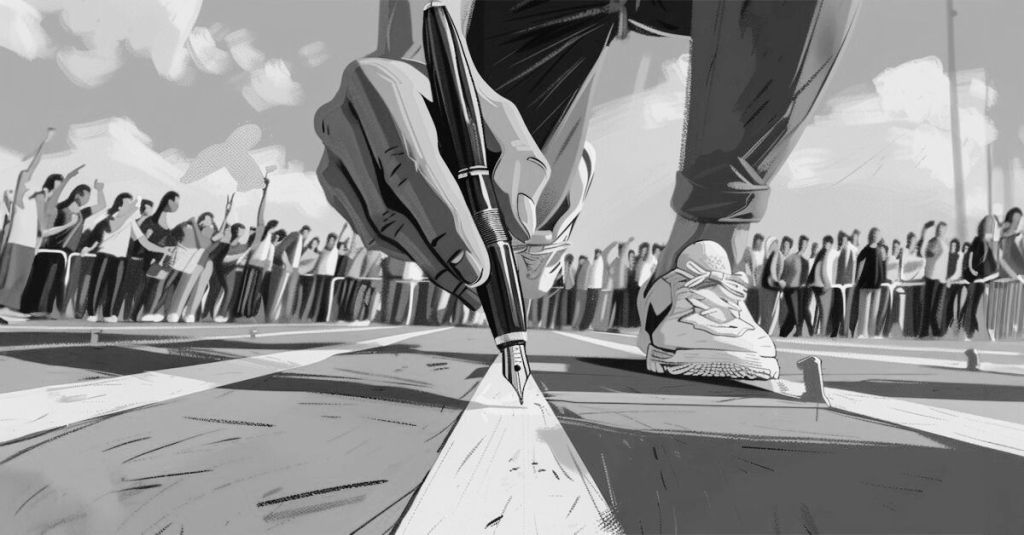
I am almost seven weeks overdue. Suddenly I remember a prayer I say with my cast and crew before we open a show— “Lord, bless our attempt to copy you as a creator.” To be creative is to copy the Creator. To be creative is to transform nothing into something. To be creative is to call forth beauty out of the void. And how did he begin? With words: Let there be light.
And so I begin with a word. The word becomes silence, becomes window, becomes title, becomes dialogue. The word is an image, a scene, a premise. The word creates space, creates structure, creates beauty. The Big Bang is an utterance, a single word perpetually expanding into a verse—a universe. Eventually it will collapse unto itself, into that single uttered word. This is how the universe began. Perhaps this is also how I should begin.
Juan Ekis is a poet, playwright, and filmmaker. He co-wrote the book and lyrics to National Artist Ryan Cayabyab’s “Lorenzo: A Rock Musical” and to Tanghalang Pilipino’s “Pingkian: Isang Musikal.” He has won multiple Palanca Awards for his plays and poetry. His plays have been staged at the Virgin Labfest, Short and Sweet Festivals, and other venues around the country and abroad. He is currently Head of Knowledge Management for Ayala Corporation.
 Journalixm