
by Leandro Reyes
Approx. reading time:
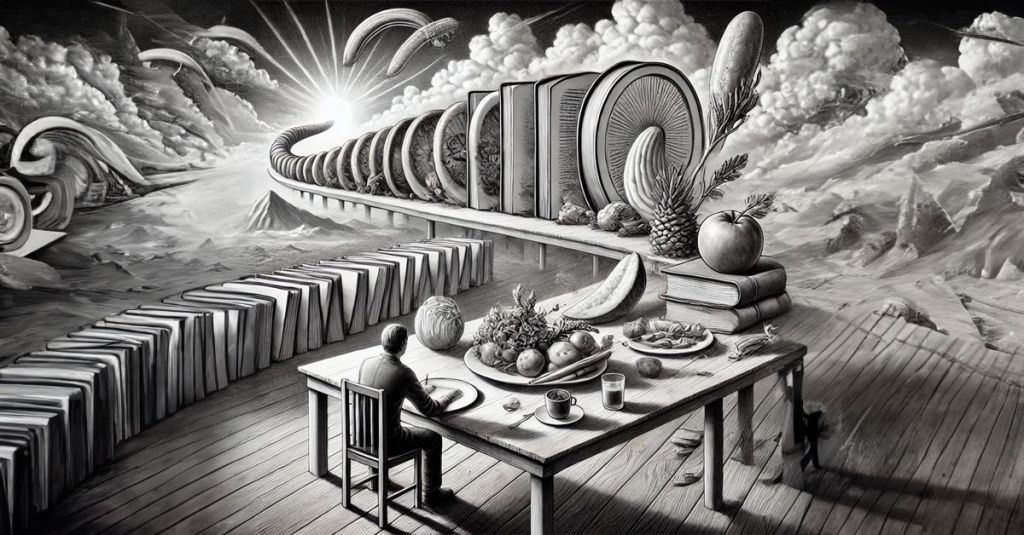
By remembering that nothing is new. When I was a child, I was hard to feed, staying seated at the table until I finished my food. “Small bites” was my father’s go-to instruction. “Before you know it, you’ll be done, and you can go back to reading.” It was not as incentivizing as he thought it was, and I associated reading with having to stay behind, so for a short while, I stopped reading altogether. The activity I enjoyed was directly linked to the activity I dreaded.
As an adult, I have renewed a fondness for both. When I was initially reflecting on the question of how to begin, like a boomerang, “small bites” was supposed to be my initial answer, and I thought it might be nice to write about that—but it wasn’t.
Admittedly, I still apply this small bites approach to my projects. After all, the overused adage “it’s going to get harder before it’s over” is annoyingly true. Having this in mind, I think to myself: If I draw towards the end with small bites, perhaps I begin with big bites?
To dive head-on and exhaust my capacity in the first few minutes of finishing my food, until it gets hard, then I seamlessly pause, immediately consumed by the want to stop but automatically confronted by the need to keep going. Then I transition to small bites until it’s over.
Maybe the reason why I think I don’t have an approach to beginnings is that I am always already thinking of the next thing before the current thing is completed. Thinking about reading when the plate is still half-full; the next project while the current project still has objectives I need to power through and stomach. Stalling in thought.
While writing this, I discovered that my current beginnings are always found in the middle of the previous project.
A few weeks ago, while doomscrolling in the middle of my busy week, I saw a social media clip talking about how procrastination temporarily protects us from discomfort and anxiety brought by tasks we dread doing. It delighted and shook me at the same time. As a writer, I rely on meandering and fascination to get the ideas in. I forage bits that I eventually use for my material. It delighted me because it made me aware that while putting off the difficulty of seeing a project through its end puts me in a state of daydreaming—seeing the exciting beginning of the next project, and that’s the exact thing that shook me too. Realizing that I tend to put off the current project’s follow-through to plan the next project.
I don’t recall what placed me in this loop, and to be honest, I have no interest in investigating where this rabbit hole started; I am more invested in where it leads to.
As a spoken word artist, I begin with a deep breath. I count silently in my head and load up the first line, making sure it will be launched with the designed tone, volume, and speed. The final three seconds before I deliver are longer in my head. After the first line has been released, I no longer have the safety of the runway. I will only trigger the next line with the current line until it’s over. Tone, volume, speed (and all the other contributing components for delivery) will be attached as the words dart out one after the other. There are no small bites in a spoken word performance; it starts big and ends bigger. Not to mention that a spoken word performance set is usually comprised of three poems, and of course, we want to end larger than we begin.
I was given a week to finish my writing. I jumped in on it on the first day. Found myself in the homestretch, and now we are here. I stopped because the end is not presenting itself as clearly as I would want it to be, and that flings me into discomfort.
The reprieve? Reverie. In days 2 to 6, I finished a zine of poems I was putting off, composed the framework on a long-term paper I will be working on (started that), and finished the final season of a TV show I have been waiting two years for, among other things.
While delaying the end of the day-one task, I had big bites elsewhere. I am trying to justify this pattern and convince myself that it’s a good thing—a net positive, if you will. But I am unsure about that currently. I don’t know how to feel about this yet, so I guess I’ll be putting it off to write about it at a separate time.
At the end (or in the beginning), I learned: the size of the bite is irrelevant, and our attachment to stages of completion is relative. The blank page can be just as intimidating as the 827th word. For now, going with this productive flow is working for me. And to be honest, I’d rather learn to navigate and maintain the flow than worry about how it all began.
Bearer of a storytelling family’s lasting legacy, Leandro Reyes, the great-grandson of Severino “Lola Basyang” Reyes, brings the craft of tale-telling into a new age; When not procrastinating or attending meetings, he actually writes poetry. Leandro is now working on his second book and two of his full length film scripts which he will eventually complete with enough prayers and pancit canton.
 Journalixm