
by Ia Tolentino & Snow Schnabel
Approx. reading time:
Is laundry a labor of love—or a mental load minefield?
In Filipino households, the division of labor often shifts slowly, unevenly. Tasks once handed down through generations of women are increasingly shared across gender and age.
Except for one.
One task has always stayed women’s work. Laundry.
Laundry, despite its seeming ordinariness, remains curiously untouched—guarded, even—by mothers who otherwise welcome help in domestic life.
At first glance, it’s counterintuitive. Washing machines are ubiquitous. Laundry products are widely available. Innovations like the “Tide Pen” have even made it convenient.
Filipino families have adapted to countless other domestic innovations with ease. And yet, across dozens of home visits and interviews conducted in Metro Manila and the Visayas over the past year, a pattern emerged: mothers continue to shoulder laundry as a solitary task, even when other household chores have been redistributed.
The reasons are rarely articulated in abstract terms. Instead, they are embedded in gesture and habit. A mother intercepts a child reaching for a detergent bottle. She checks a collar before it enters the drum. She insists: “Hindi mo matatantsa.”
Tantsa—an untranslatable concept that blends estimation, experience, and economy—is at the heart of the matter. Without standardized measuring systems (few local detergents or conditioners come with scoops or clear instructions), household laundry becomes a matter of feel. A pour that is too generous wastes product; one that is too stingy results in clothes that remain visibly unclean. Most mothers interviewed described a personal, practiced system of estimation, developed over years of improvisation with refilled sachets and repurposed kitchen cups.
This quiet expertise has a lineage. In the pre-industrial era, laundering was one of the most labor-intensive aspects of domestic life. In many parts of the world, it took entire days—sometimes weeks—of soaking, scrubbing, boiling, wringing, and drying, often outdoors and in communal spaces. In colonial Manila, women beat clothing against stones in riverbanks or used wood-fired cauldrons to boil linens. In Europe, launderers guarded their concoctions of ash, soap, and lye like trade secrets. Across cultures, it was a chore that fused chemistry, intuition, and physical endurance.
Modern appliances promised to collapse all that into a few buttons and a rinse cycle. And to some extent, they did. But even now, the process resists full automation. Garments still vary in weight, colorfastness, and sensitivity to heat. Stains still require pre-treatment. And crucially, the knowledge of how to manage these variables remains unevenly distributed within the home.
Compounding the issue is the rising cost of basic goods. Detergent and conditioner are often bought in bulk, not because families expect to use them quickly, but because price per unit is lower. Overuse, especially in the Global South, becomes not merely a household inefficiency but a financial misstep. In this context, laundry ceases to be a routine chore and becomes a fragile system of micro-management—one vulnerable to error when delegated to the untrained.
This is not a matter of personal preference so much as structural logic. Mothers speak of laundry not as a symbolic act of care, but as a practical one. They know what detergent ratios keep the towels from becoming stiff. They know which shirts require soaks or hand washing, which can go straight into the spin cycle, and which must be line-dried to avoid shrinking. In households with limited water pressure or irregular electricity, these details matter. Efficiency becomes a form of resilience. All this maintenance is structured on top of the economics of keeping garments usable and presentable for as long as possible.
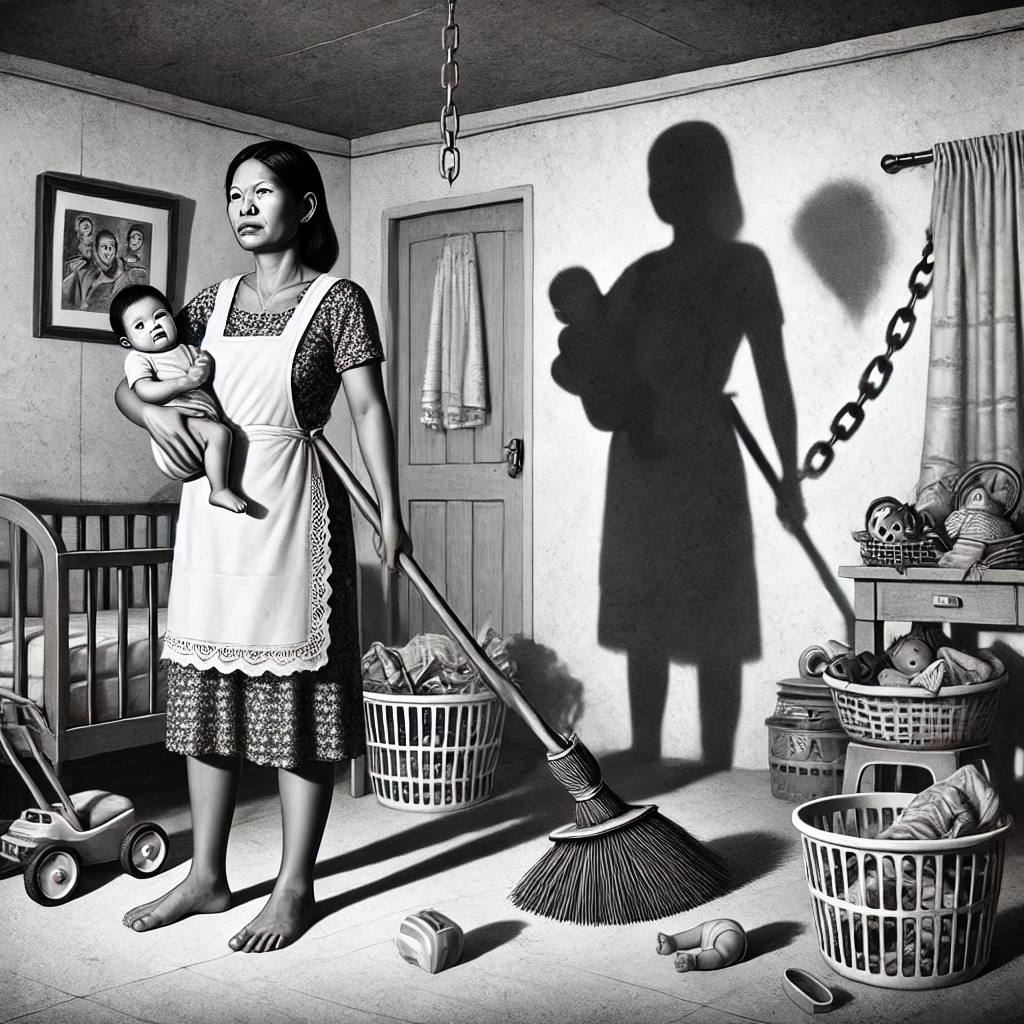
Beyond technique and thrift lies a deeper structure: the mental load. Though the term originates from Western feminist theory, its local manifestations are precise and observable. Laundry is not simply the act of washing; it is the orchestration of a complex sequence: sorting by color and fabric, identifying special-care garments, checking pockets, treating stains, calculating product usage, scheduling around weather or appliance availability. Mothers internalize this sequence. It becomes invisible labor, the kind that is neither seen nor easily shared.
This invisibility makes it difficult to reassign. While other tasks—cooking, cleaning, grocery runs—can be taught or outsourced in discrete units, laundry requires a longer arc of attention. A missed stain is only discovered after the shirt has dried. An improper detergent leaves a residue that surfaces days later. The temporal dislocation between action and consequence makes training others costly.
The effect is subtle but far-reaching. In the automation of laundry—its mechanical, almost silent repetition—we risk underestimating its complexity. The washing machine promised liberation, and in many ways delivered it. But it also rendered the labor less visible, less narrativized. In doing so, it helped solidify laundry as a site of unshared expertise—technical, economic, and affective.
In several homes, the machine itself has become a symbol of delegation deferred. The children are taught to fold, to carry, to hang—but rarely to load. When asked why, one mother in Cavite answered plainly: “Ayoko nang sayangin.” Not time. Not even effort. But product, and by extension, control over outcome. A single laundry misstep—a shirt shrunk, a school uniform stained—carries consequences that ripple outward. In a country where appearances still shape access to jobs, to education, to mobility, laundry is not just about cleanliness. It is about risk mitigation.
What appears at first as a preference is, in fact, an index of burden.
 Journalixm