
by the Journalixm Staff with Fay Ballo, Brand Y
Approx. reading time:
When Cardinal Luis Antonio Tagle’s name began circulating once more in the lead-up to the conclave, a familiar current ran through the Filipino Catholic imagination. There was hope, and pride, and perhaps a flicker of destiny. For many, his potential papacy was more than a symbolic breakthrough; it felt like a culmination: of centuries of fidelity, of global diaspora, of a Church in the periphery ready to take the helm.
That moment has passed. The College of Cardinals has chosen Robert Francis Prevost of Chicago, now Pope Leo XIV, as the new Bishop of Rome. Another Filipino prelate, Cardinal Pablo Virgilio David, affectionately called Bishop Ambo, was also mentioned in pre-conclave coverage as a rising voice of the Global South, but the decision took a different turn.
Even so, the moments leading up to the conclave, our national response, and what they reveal about us as a Catholic country merit deeper reflection.
Devout, Yet at a Distance
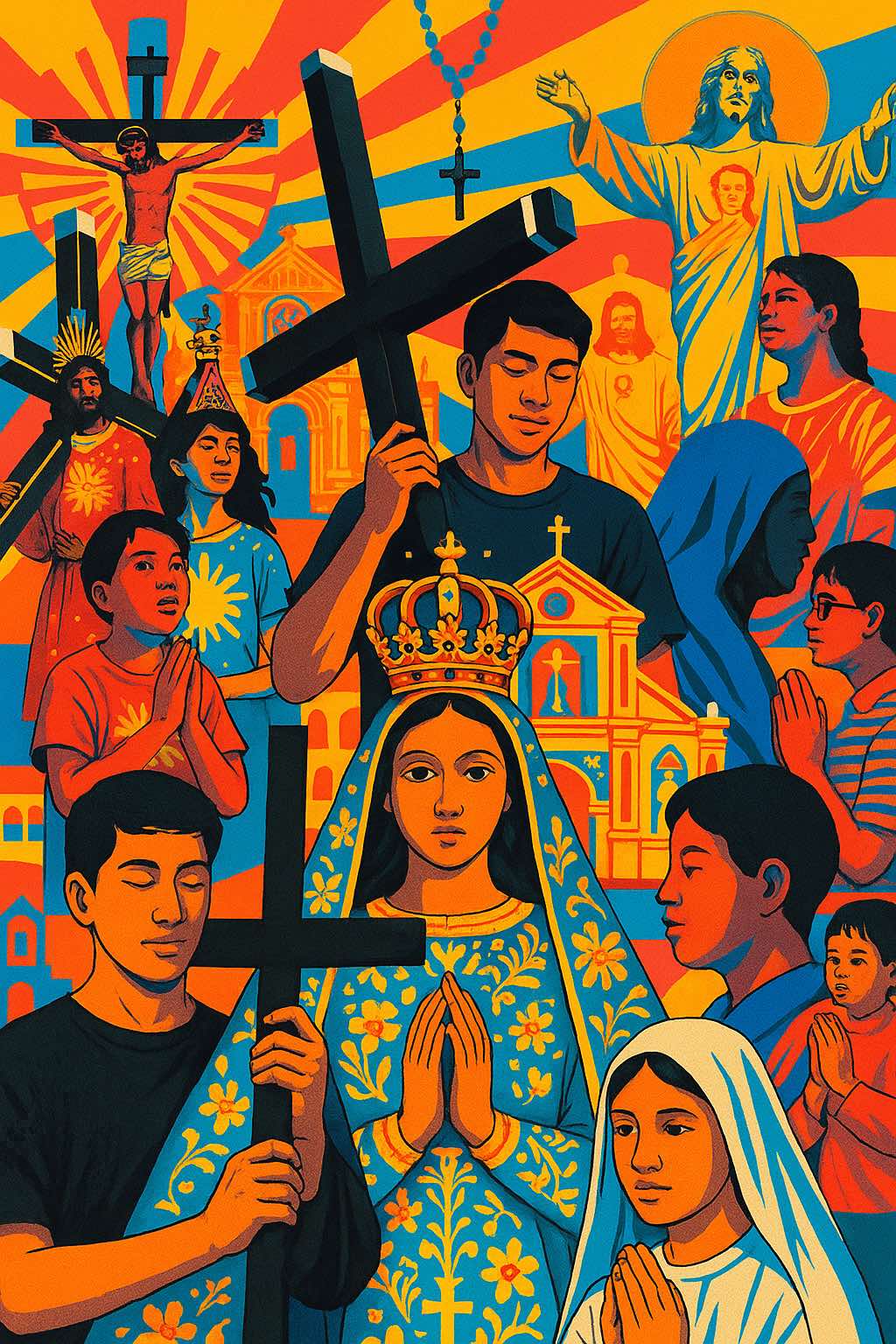
The Philippines is, by every demographic measure, a Catholic stronghold. Nearly 79 percent of the population identifies as Roman Catholic. Churches remain full, religious iconography remains central, and faith continues to shape everything from festivals to politics.
Demography, however, does not guarantee direction. The election of Pope Leo XIV reminds us that size and influence do not always move together. In this light, the question, “Is the Philippines ready for a pope?” becomes less a matter of external standing and more a reflection of inward readiness. What exactly do we seek in raising such a question? Do we long for representation, affirmation, or something deeper that we haven’t yet fully articulated?
The Gap Between Confidence and Culture
The Catholic Church is evolving not only in geography but also in its ways of thinking and acting. Authority is no longer limited to central figures or top-down decisions. Over the past years, it seems that the Church has been listening to a broader range of voices, allowing them to inform how it responds. In a world where political systems grow more rigid and public discourse more divided, the Church appears to be moving in its own direction—toward inclusion, patience, and at least incrementally, the recognition of each person’s complexity.
This changing approach casts new light on some persistent features of Filipino Catholic life. Despite strong participation and visible devotion, many local practices remain rooted in inherited forms of authority and expression. Parishes remain hesitant to engage in open conversation on gender and family. The moral high ground is still often held through assertion rather than accompaniment.
This tension becomes clearer when we look beyond church structures, into the everyday rhythms of Filipino family life. The Hakuhodo Institute of Life and Living ASEAN 2024 study, which tracked evolving life values across Southeast Asia, introduced two telling archetypes emerging in the Filipino household: the “Syncretic Family” and the “Weaving Family.” The Syncretic Family is characterized by its ability to hold seemingly opposing values in the same space—traditional religious practices coexist with openness to new moral frameworks, and respect for elders remains strong even as younger members pursue more individualistic or unconventional paths. Meanwhile, the Weaving Family reflects a more fluid, dynamic configuration of kinship itself, where the definition of family expands to include not only extended relatives but also non-blood relations such as close friends, mentors, and even co-workers. These models highlight how Filipino families increasingly blend inherited beliefs with contemporary realities—holding fast to traditional notions and to faith while adapting to the fragmented, pluralistic lives they now live, often prioritizing emotional closeness and shared purpose over strict hierarchy or structure.
In this light, Filipino Catholicism is also changing, albeit unevenly. The gap between formal Church teaching and lived faith remains. Many younger Filipinos still identify as Catholic but approach their beliefs in more personal, less institutional ways. Yet the structures of Church discourse remain largely unchanged. The issue is not only doctrinal, but also emotional. Confidence in religious practice may still coexist with a deep need for better listening.
Projections and Aspirations
Tagle, in many ways, became a vessel for a particular Filipino longing: a soft-spoken, tearful, deeply educated cleric who seemed to bridge the distance between Rome and Quiapo, between tradition and tenderness. His ascent within the Vatican felt like our own story moving upstream, from colonial evangelized to global evangelizer.
There is something revealing in the way Cardinal Tagle’s rise was received—not only as a personal achievement, but as a mirror of collective aspiration. His presence in the Vatican became, for many, a symbol of Filipino faith stepping onto the world stage: gentle, articulate, bridge-building. Alongside him, the mentions of Bishop Pablo Virgilio David as a dark horse papabile has offered a different but equally resonant image. More outspoken, Bishop Ambo has been widely recognized for his courage during periods of political unrest, especially for his clear stance against murder and state-induced cruelty and violence. Together, the two figures embody contrasting but complementary threads in the Filipino Church: one rooted in dialogue and humility, the other in courage and resistance.
Their global recognition brings to light the stories we tell about ourselves—and the ones we hope the world will affirm. But it also points to something deeper. Their visibility drew focus to the kinds of stories we want to tell about ourselves; at the same time, it raised questions. Why does recognition often feel strongest when it comes from outside? Why do many of our most hopeful symbols rise only when validated by a broader stage? And how do we hold that alongside the continued experience of marginalization felt by many Filipino Catholics at home—especially the young, the poor, and those who live at the Church’s social and doctrinal margins?
What Leo XIV Signals
Pope Leo XIV, formerly Cardinal Prevost, is an American who spent many years serving in Peru and leading a religious order. His background includes work across cultures and experience in both pastoral and administrative roles. His election may reflect a continued interest in reform, especially in the spirit of Pope Francis, while also favoring candidates who can operate within the established systems of Church governance. That he comes from the United States—at a time when American society continues to wrestle with deep political divides and questions of moral leadership—adds another layer of interest, suggesting the Church’s choice was made with both global resonance and quiet contrast in mind.
In a Church that is increasingly shaped by Latin American movements, African growth, Asian devotion, and a complex mix of renewal and fatigue in the West, the Filipino Church holds a visible but still evolving place. It is neither at the margins nor at the center. This in-between position invites reflection rather than conclusion. It raises questions about how we live our faith at home– with passion, yes, but more importantly with coherence.
It may be worth asking what it is we truly seek. Is it influence, recognition, or something more difficult to name—a sense of being understood, of mattering in the larger story of the Church? Whatever the shape of that longing, the way forward likely rests less in drawing closer to Rome, and more in turning inward with clarity: attending to the contrast between our warmth and our hesitations, between the depth of our devotion and the silences that still surround questions of justice, belonging, and voice.
A Quiet Invitation
The attention surrounding Cardinal Tagle and Cardinal David opened a view into how the Filipino Church understands itself and how it hopes to be understood. Their rise drew attention to questions of identity, voice, and direction in a Church that is itself adjusting to new pressures and possibilities. The election of Pope Leo XIV failed to fulfill the narrative of our particular national imagination, but it did not end the conversation either.
What remains is a set of tensions that still seek response: between being seen and being heard, between preserving tradition and embracing change, between national pride and pastoral relevance. These questions are not limited to the Philippines, but they carry specific weight here, where faith is both deeply rooted and constantly reinterpreted.
The past days unravelled a thread worth following, and the work ahead lies in thoughtful leadership at the local level, greater openness within our communities, and the ongoing effort to reflect more clearly the Church we hope to build. This task is slow, often unseen, and yet necessary—because the Church will not be defined elsewhere; it is already growing in the lives we lead here.
 Journalixm